
The ratio of market capitalisation to gross domestic product (GDP) in India remains elevated despite the recent correction in the equities markets. It was 147.5 per cent on December 3, 56 per cent higher than the 10-year average of 94 per cent. The current ratio is slightly lower than the all-time high ratio of 154 per cent at the end of September this year.

Foreign investors have continued selling in the Indian market, pulling out a massive Rs 85,790 crore (around $10.2 billion) from equities this month due to Chinese stimulus measures, attractive stock valuations, and the elevated pricing of domestic equities. October is turning into the worst-ever month in terms of foreign fund outflows. In March 2020, FPIs withdrew Rs 61,973 crore from equities.

When Gensol Engineering made its public market debut through a small and medium enterprises (SME) initial public offering (IPO) in September 2019, its promoters held a commanding 96 per cent stake. Now, that figure has shrunk to a "negligible" fraction.

These 10 stocks represent the best mix of value and growth, offering relatively low price-to-earnings and price-to-book ratios, a high return on equity, and sufficiently high potential from current levels.

The total market valuation of the BSE-listed companies surged to an all-time high of Rs 107 lakh crore on Thursday.

On average, stocks that debuted last year are down 37 per cent from their peak levels.

Zetwerk Manufacturing, a $3.1 billion company in the contract manufacturing space, is planning to come up with an initial public offering within the next 15-24 months, a top company executive said on Saturday. The Bengaluru-based company aims to raise at least $500 million, targeting a valuation of around $5 billion.

Indian startups raised a total of $1.65 billion (about Rs 14,418 crore) in funding at a median valuation of $83.2 million in February 2025, according to data from Traxcn. This brings the total funding in FY25 (April-February) to $25.4 billion, spread across 2,200 rounds, the data showed.

Among the Sensex firms, Axis Bank, Mahindra & Mahindra, Wipro, Tata Motors, HDFC Bank, Tech Mahindra, ICICI Bank, JSW Steel, Tata Consultancy Services, Infosys, HCL Technologies and Bharti Airtel were the major gainers. Nestle, Titan, Bajaj Finserv and UltraTech Cement were the laggards.

'IPOs have performed exceptionally well, with a notable increase in average ticket size from Rs 800 crore in the last financial year to around Rs 1,300 crore in this financial year.'

Stocks of all the ten listed Adani Group firms ended with gains on Wednesday, continuing the positive momentum amid a recovery in the broader equity market. Adani Enterprises stock jumped 14.70 per cent to settle at Rs 1,564.55 on the BSE. In intra-day trade, it rallied 15.83 per cent to Rs 1,580.

'Expect FPIs to continue selling for several months until the rupee stabilises.'

Foreign investors have pulled out Rs 44,396 crore from Indian equities this month, driven by strength of the dollar, rising bond yields in the US, and expectations of a weak earnings season. This came following an investment of Rs 15,446 crore in the month of December, data with the depositories showed.

Foreign investors have withdrawn Rs 22,194 crore from Indian equities this month, driven by expectations of a weak earnings season, a steady rise in the US dollar, and concerns over tariff war during Donald Trump's presidency. This came following an investment of Rs 15,446 crore in the month of December, data with the depositories showed.

'There's a misconception that all Rs 1 lakh crore will be spent immediately, leading to higher consumption of FMCG goods, travel, and vehicle purchases.' 'While some of this money will go toward consumption, not all of it will.' 'The impact depends on where people deploy their savings.'

Most market analysts are expecting the momentum to shift towards 'quality' and 'growth' stocks in 2024 after the outperformance of 'value' stocks over the past three years. 'Value' stocks are generally well-established companies with steady profits that are trading at a discount to what they are intrinsically worth. Companies in sectors such as commodities, industrials, commercial vehicles and public sector units (PSUs) fall in this bracket.

'More than investors, fund houses, and advisors have raised caution and limited flows on small-and mid-caps.'

Equity market capitalisation dropped to a seven-month low in February, with the top 10 companies losing a whopping Rs 3,33,307.62 crore in market valuation last week. The total equity market capitalisation (m-cap) in February 2022 stood at Rs 2,49,97,053.39 crore. The previous low was in July 2021, when the m-cap of BSE-listed companies was at Rs 2,35,49,748.9 crore. In January, the m-cap stood at Rs 2,64,41,207.18 crore.
The Reserve Bank of India's (RBI's) $10 billion US dollar-rupee buy-sell swap auction for three years received bids worth $16.23 billion on Friday, reflecting robust demand amid persistent liquidity deficit in the banking system. This was the second swap auction by the central bank after it infused $5 billion via six month-swap on January 31.

Most global as well as domestic brokerages are upbeat on India's largest IT services provider, Tata Consultancy Services (TCS), despite its performance during the December quarter of FY25, when it missed Street estimates. On the bourses, the TCS share price rallied as much as 6.44 per cent to hit an intraday high of Rs 4,296.80 apiece, before settling 5.67 per cent higher at Rs 4,265.55.

Among Sensex shares, HCLTech, Asian Paints, Maruti, JSW Steel, TCS, SBI, ITC and Bharti Airtel were the major losers. On the other hand, Bajaj Finserv, Mahindra & Mahindra, Titan, L&T and Wipro were the major gainers.

'Investors with foreign currency-denominated goals, such as foreign education or foreign travel, should go for US equity funds.'

'As we navigate uncertain waters, a conservative approach to largecap investing could provide a strategic advantage.'

The last time these two indexes recorded a negative performance on a calendar year basis was in CY19.

The bias for the BSE benchmark index, technical charts suggest, is likely to remain bullish as long as the index holds above 75,600 levels for the rest of the year.

The Securities and Exchange Board of India (Sebi) has asked fund houses operating smallcap funds with a large corpus to share data on their holdings in the total free float of smallcap stocks, according to sources. This is part of the stress tests that the regulator wants fund houses to undertake amid a surge in inflows into smallcap schemes and growing concerns about valuations. Free float refers to the quantum of freely available shares for trading on the stock market.

Havells India, the country's largest listed consumer electrical company, reported a mixed performance in the 2024-25 (FY25) October-December quarter (Q3). While the top line benefited from festival demand, lower margins impacted operational performance.

Equity benchmark indices Sensex and Nifty settled lower for the sixth straight session on Monday due to heavy selling in bellwether stocks including HDFC Bank and Reliance Industries amid mixed trends in the global markets and outflow of foreign funds. Falling for the sixth consecutive session, the BSE Sensex tumbled 638.45 points or 0.78 per cent to settle at 81,050. During the day, it plummeted 962.39 points or 1.17 per cent to 80,726.06. The NSE Nifty slumped 218.85 points or 0.87 per cent to end at 24,795.75.

The exodus of FPIs from the Indian equity markets continues unabated, as they withdrew Rs 64,156 crore ($7.44 billion) this month so far on depreciation of the rupee, rise in the US bond yields and expectation of a tepid earning season. This came after an investment of Rs 15,446 crore in the entire December, data with the depositories showed.

Alternative Investment Funds (AIFs) with a lock-in period performed better than the ones that allow investors to withdraw capital at any time. Close-ended schemes had a median return of 5.62 per cent in December, according to data from industry tracker PMSBazaar. The median returns for open-ended schemes were 3.91 per cent

Foreign portfolio investors (FPIs) have invested Rs 25,300 crore through the anchor book for IPOs in 2024, surpassing the Rs 20,351 crore invested by domestic mutual funds (MFs). FPIs accounted for 46.6 per cent of shares sold in the anchor category, the highest share since 2021, according to PRIME Database.

JSW Steel, owned by Sajjan Jindal, has emerged as the world's most valuable steelmaker, boasting a market capitalisation (mcap) of nearly $30.31 billion, according to Bloomberg data.
Eight of the top-10 most valued firms together lost Rs 2,21,555.61 crore from their market valuation last week in-line with the weak trend in the broader market, with Infosys and HDFC Bank suffering the biggest hit. The 30-share benchmark index, Sensex, lost 1,141.78 points or 1.95 per cent last week. From the top-10 pack, only Reliance Industries and Adani Green Energy emerged as the gainers.

Following the sharp run in markets, valuations across the board have become elevated. The National Stock Exchange Nifty50 Index now trades at a 12-month trailing price-to-earnings (P/E) multiple of 24.3 times, 18 per cent higher than this year's low of 20.5 times. The valuation expansion in the broader markets has been sharper.

Housing sales rose 7 per cent annually in 2024 across eight major cities to reach 12-year high at 3,50,613 units on better demand for premium homes amid stable mortgage rates and strong economic growth, according to Knight Frank. Last month, real estate consultant Anarock, however, had reported that housing sales declined 4 per cent in 2024 to nearly 4.6 lakh units across seven major cities.

Reliance Jio, the telecom business of the Mukesh Ambani-promoted conglomerate, is expected to go for an initial public offering (IPO) of over $6.25 billion either in the second or the third quarter of the calendar year 2025, sources said. Reliance Retail is likely to be listed around the same time with a short gap, it is learnt. The timing of the two IPOs, however, will depend on the company's assessment of the market conditions among other factors.

After a brutal selloff since October, foreign portfolio investor (FPI) flows for the year-to-date (YTD) in 2024 have turned negative. In early September, YTD FPI investments peaked at a record Rs 22,000 crore ($2.6 billion). This wave of selling has also pulled down benchmark indices, with the Nifty's YTD returns declining to 11 per cent from their high of 21 per cent in September.
Brokerages believe that the Bharatiya Janata Party's (BJP's) stronger-than-expected showing in state elections reduces political risks for the domestic markets going into 2024. However, after the short-term excitement, the focus will soon shift to earnings, global liquidity conditions, and the interest rate trajectory. "BJP's win in the three state elections is much better than what exit polls suggested and reinforces the consensus expectations of a Modi win in the 2024 national elections with a greater likelihood of 300+ seats for the BJP.
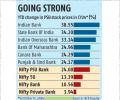
Stock Market News today, PSU banks: The year 2024 was a roller-coaster ride for Indian stock markets, marked by volatility driven by the Lok Sabha elections, Union Budget 2024, a slowdown in corporate earnings, and sticky inflation. Geopolitical tensions - particularly between Israel and Iran in West Asia - along with various stimulus announcements by China and yen carry trade rocked the equity markets throughout the year.

The stock of India's largest listed pure play retail major Trent was down 14.76 per cent at close on Monday after a fall in revenue growth for the March quarter of 2024-25 (Q4FY25). The sales growth trajectory has been in a declining trend over the last few quarters, which, coupled with falling operational metrics, higher competitive intensity, and expensive valuations, has seen the stock crack about 44 per cent since its 52-week highs in October last year.
